tourmaline · october birthstone · stone guides
October Birthstone Tourmaline: Meaning, Colors, Chakras & Care
The October birthstone explained: tourmaline meaning, history, color meanings, chakras, sleep, intentions, spotting fakes, care and which wrist to wear it on.
By LME Jewelry10 min read
Key takeaways
- Tourmaline is one of two October birthstones (with opal). It is the tougher, more colorful choice for jewelry you wear every day.
- It grows in more colors than almost any other gem, and a single crystal can hold two or three colors at once.
- In crystal tradition it is the "lucky stone": linked with protection, good fortune, a lighter mood and emotional balance.
- Each color has its own chakra and intention. A rainbow "candy" strand brings them together.
- Real tourmaline shows natural color variety, fine inner inclusions and a gentle color shift as you turn it.
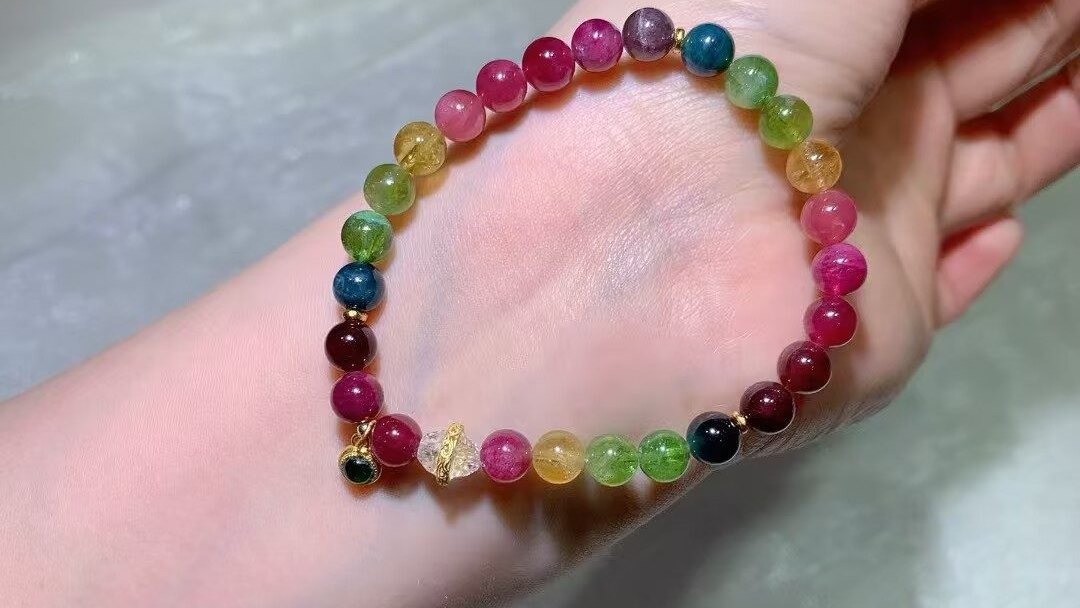
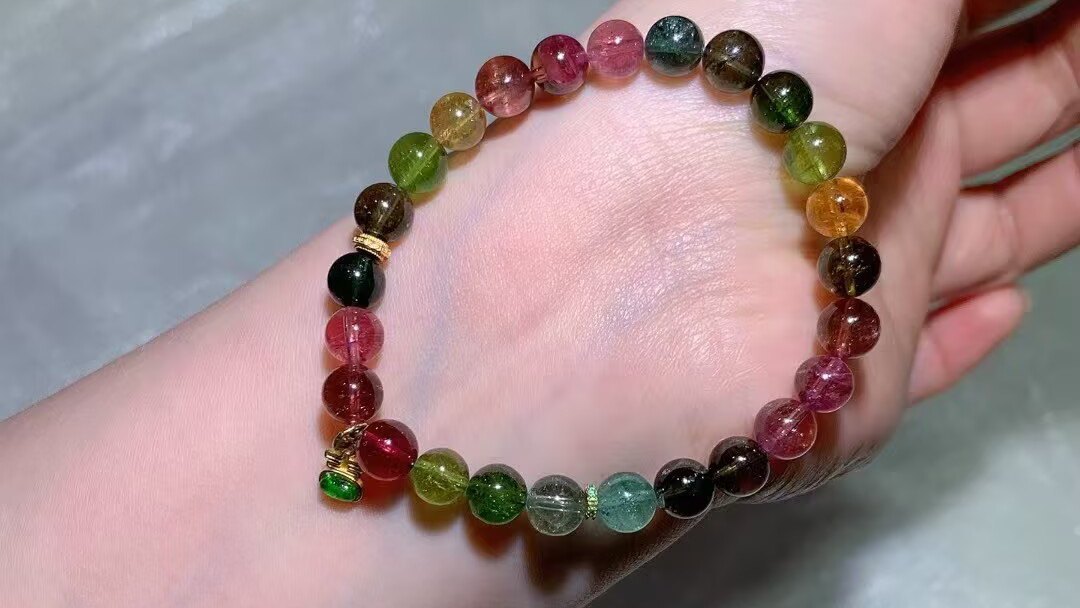
If you were born in October, you have a lucky choice to make. Your month has two birthstones, and one of them comes in nearly every color there is. Tourmaline can be raspberry pink, forest green, honey yellow, ocean blue or deep ink, and sometimes it is several of those in one small bead.
This guide covers everything we wish we had found in one place: what tourmaline means, where its lore comes from, what each color stands for, how people use it for emotional balance and rest, how to spot a fake, and how to wear and care for a tourmaline bracelet.
Why Tourmaline Is the October Birthstone
October is one of the few months with two official birthstones. Opal is the older, traditional stone. Tourmaline, and pink tourmaline especially, was added to the modern birthstone list in the twentieth century and has become a favorite.
There is a practical reason. Opal is soft and delicate, while tourmaline sits at about 7 to 7.5 on the Mohs hardness scale, so it is much better suited to a bracelet you wear every day. It also offers far more choice: whatever someone's favorite color, there is a tourmaline to match. Tourmaline is also the traditional gem for the eighth wedding anniversary, which makes it a thoughtful October anniversary gift too.
Tourmaline Meaning and History
A name that means "mixed stones"
The word tourmaline is usually traced to the Sinhalese word turmali, a name for mixed, colorful gem pebbles. It suits a stone that rarely sticks to one color. For centuries, merchants mistook tourmaline for other gems: green crystals were sold as emerald and red ones as ruby, and it took modern mineralogy to show they were a family of their own.
The "ash puller"
Tourmaline has an unusual physical talent. When it is warmed or rubbed, it builds up a small electric charge and can attract dust and ash. Dutch traders are said to have used heated tourmaline to pull ash from their pipes, and called it aschentrekker, or "ash puller". Scientists call this effect pyroelectricity, and tourmaline is one of the best-known minerals that shows it. This lively, charged character is part of why crystal lovers see tourmaline as an energetic, protective stone.
Treasured in the imperial court
Pink tourmaline was a prized stone in the late Qing court. Empress Dowager Cixi is famously said to have loved it, and carved pink tourmaline pieces were treasured there. Today many people simply call tourmaline the "lucky stone", worn to keep bad energy away and to welcome blessings in.
Key properties at a glance
| Property | Tourmaline |
|---|---|
| Mineral family | A group of closely related boron silicate minerals |
| Hardness (Mohs) | About 7 to 7.5 |
| Colors | Nearly every color, often two or more in one crystal |
| Special trait | Builds a small charge when warmed or pressed |
| Birthstone | October (with opal) |
| Anniversary | 8th |
What Each Tourmaline Color Means
Every color of tourmaline has its own traditional meaning. Here are the ones you will see most often, including in a candy tourmaline strand:
| Color | Common name | Traditional meaning | Chakra |
|---|---|---|---|
| Pink to red | Pink tourmaline, rubellite | Love, compassion, self-kindness | Heart |
| Green | Green tourmaline | Growth, vitality, abundance | Heart |
| Yellow to orange | Yellow tourmaline | Joy, confidence, warmth | Solar plexus |
| Blue to teal | Blue tourmaline | Calm, honest expression | Throat |
| Black | Black tourmaline | Protection, grounding, stability | Root |
| Pink and green in one stone | Watermelon tourmaline | Balance between giving and receiving | Heart |
| Many colors together | Candy or rainbow tourmaline | All of the above, in balance | All seven |
That last row is why a mixed strand is so loved. Instead of choosing one intention, you wear the whole rainbow.
Tourmaline Healing Energy: Chakras and Balance
In crystal tradition, tourmaline is linked with:
- Chakra balance: because it comes in so many colors, mixed tourmaline is traditionally associated with balancing all seven chakras. Pink and green speak to the heart, black to the root, yellow to the solar plexus and blue to the throat.
- Protection: tourmaline is known as a protective stone. It is believed to shield you from negative energy and help you feel safe and grounded, especially in busy or draining places.
- Luck and blessings: its "lucky stone" reputation makes it a favorite for new chapters, from a new job to a new home.
- Joy and vitality: bright tourmaline colors are traditionally worn to invite fresh energy and a playful, optimistic spirit.
Tourmaline for Emotions and Sleep
Many people choose tourmaline when life feels heavy. Its cheerful colors are often used as a mood lift, a small, bright reminder to find some lightness in the day. Pink and green beads are linked with emotional balance and self-kindness, while black tourmaline is linked with feeling steady and protected when you feel scattered.
For rest, try a simple evening habit. Take your bracelet off before bed and set it on your nightstand. As you put it down, take three slow breaths and let the day go. Many people find the ritual itself calming: the stone becomes a cue to slow down. We recommend not wearing it overnight, so the stretch cord stays in good shape.
Intentions Tourmaline Suits
Tourmaline suits intentions like these:
- Good luck and blessings for a new beginning: a move, a new role, a graduation.
- Protection when you want to feel safe, grounded and less affected by other people's moods.
- Everyday joy when you want a brighter, more playful outlook.
- Self-love and kindness (pink and green beads) when you are learning to be gentler with yourself.
- Confident expression (yellow and blue beads) before a presentation, an interview or a hard conversation.
A simple way to start: when your bracelet arrives, wipe it with a soft cloth, hold it for a moment, and say your intention out loud. Wear it as a daily reminder.
How to Tell If Tourmaline Is Real
Colorful "tourmaline" is often imitated with dyed crystal, dyed jade or glass. These checks help:
- Look for natural color variety. Real candy tourmaline has uneven, natural shades. Some beads are clearer, some deeper, and some show two tones in one bead. A strand where every bead is perfectly bright and identical, like a paint chart, is a warning sign.
- Find the inclusions. Hold a bead up to daylight. Natural tourmaline often shows fine lines, tiny fractures or wispy threads inside the bead. Glass tends to look too clean or shows perfectly round bubbles.
- Turn it slowly. Tourmaline often looks lighter or deeper depending on the angle you view it from. Gemologists call this pleochroism. Glass looks the same from every side.
- Check the drill holes and cracks. Dye collects where it can soak in. Color that gathers around drill holes or along cracks usually means dyed stone.
- Feel the temperature and weight. Natural tourmaline feels cool and solid. Glass and plastic warm up faster and can feel lighter.
- Be realistic about price and ask questions. Fine, bright tourmaline takes time to collect and match, so a full rainbow strand at a very low price deserves a closer look. A good seller shows photos of the real piece and answers questions honestly.
Skip home "tests" like scratching, heating or rubbing to see if dust sticks. They are unreliable on finished beads and can damage the stone or the cord. If you need certainty for a high-value piece, a gem lab can confirm it.
| What you check | Natural tourmaline | Dyed crystal or jade | Glass |
|---|---|---|---|
| Color | Uneven, natural, some two-tone beads | Very even, often too bright | Perfectly uniform |
| Inside the bead | Fine lines and threads | Color sits in cracks | Round bubbles or swirls |
| Turning the bead | Color shifts with the angle | Little change | No change |
| Drill holes | Natural color to the edge | Darker color rings | Clean, glassy |
| In the hand | Cool, solid | Cool | Warms quickly |
Cleansing and Care
Energy cleansing (pick what feels right):
- Moonlight: leave it on a windowsill overnight, especially at the full moon.
- Sound: ring a singing bowl, bell or chime near the bracelet for a minute.
- Smoke: pass it gently through the smoke of sage, palo santo or incense.
- Selenite: rest it on a selenite plate or charging bowl overnight.
Everyday care:
- Avoid strong heat and long hours of direct sun. Tourmaline does not like sudden temperature changes, and some colors, especially pinks, can fade with long exposure.
- Keep it away from chemicals: perfume, lotion, cleaning products, chlorine and hot water. Put on perfume first, then your bracelet.
- Take it off before showering, swimming, exercising and sleeping to protect the stretch cord and the vintage-style accents.
- Wipe, don't soak. Use a soft, dry or slightly damp cloth, and skip ultrasonic or steam cleaners.
- Store it on its own in a soft pouch so harder stones don't scratch it.
For step-by-step rituals, read our guide on how to cleanse a crystal bracelet.
Which Wrist Should You Wear Tourmaline On?
In crystal tradition, the left wrist is the receiving side. Wear tourmaline on your left to welcome in luck, blessings and joyful energy. The right wrist is the giving or releasing side. Wear it on your right when you want to let go of stress or negativity and feel protected.
There is no wrong answer. Choose the side that matches your intention, or switch whenever you like.
What to Pair Tourmaline With
- Star rose quartz doubles the heart energy of pink and green beads. See our Star Rose Quartz Bracelet and our guide to rose quartz meaning and which wrist to wear it on.
- Super Seven adds a deeper, earthy tone to a bright stack, and both stones are traditionally linked with protection and luck. Read what Super Seven really is.
- Clear or white crystal is a calm, neutral partner that lets tourmaline's colors stand out, like the soft strands of our White Rabbit Hair Quartz Bracelet. Read our rabbit hair quartz guide.
- A single-color stack: if you love one color in your candy strand, pick up that shade in another bracelet for a coordinated look.
- Black rutilated quartz is a natural match: its dark needles are often black tourmaline sealed inside clear crystal. See black vs titanium rutilated quartz.
- Garnet deepens the red and root-chakra side of a candy strand with a warm wine-red glow. Read our garnet meaning guide.
- Amethyst adds calm violet to a bright stack. See amethyst meaning and which wrist.
- A multi-gem mix is the natural next step if you love many colors at once. Read our multi-gem bracelet guide.
Our Candy Tourmaline Bracelets
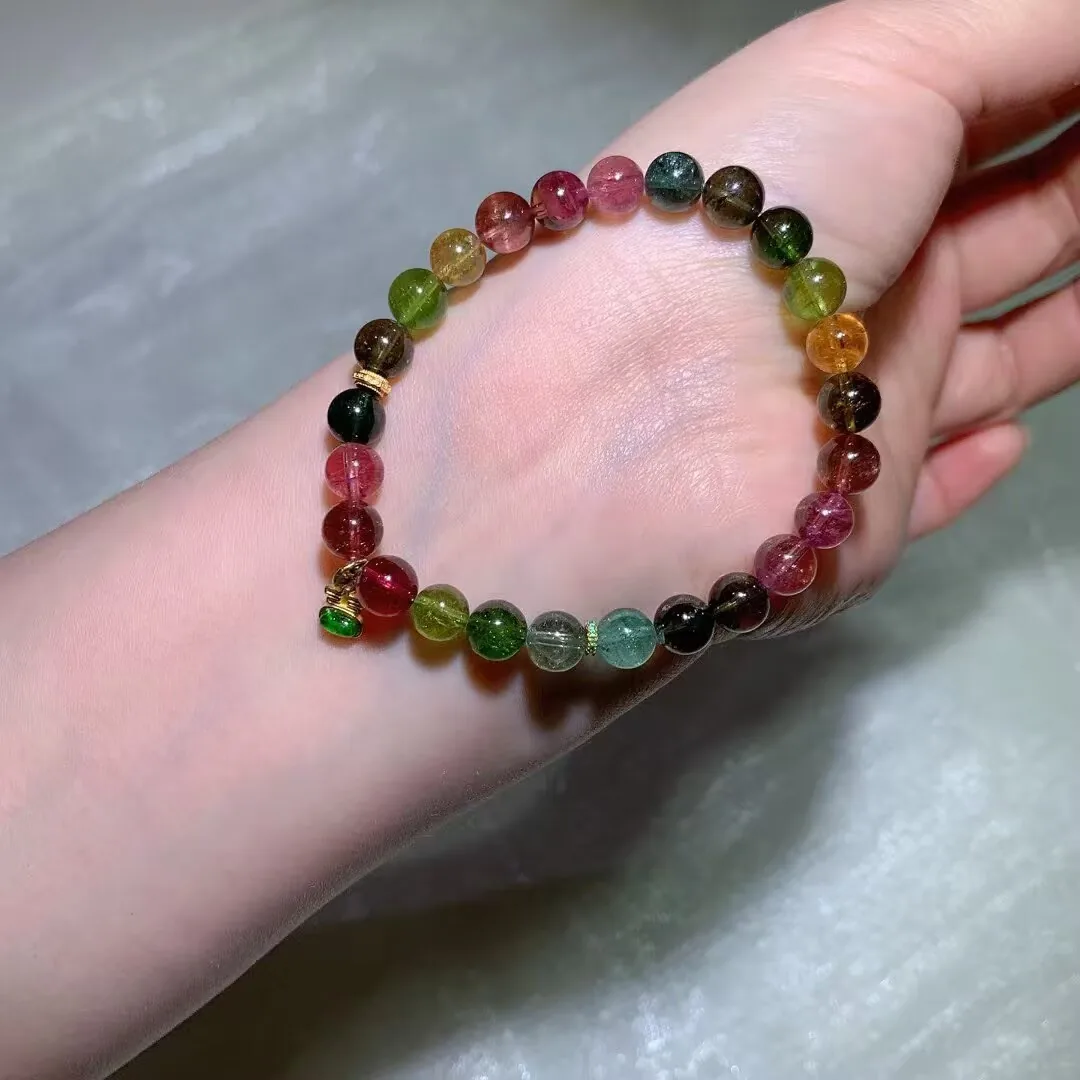
We make two candy tourmaline bracelets. Both use natural mixed-color tourmaline, hand-picked bead by bead for color, clarity and shine, then arranged so the rainbow feels balanced around the wrist. Each is an original LME design, handmade one strand at a time.
The 6.5mm strand is delicate and light, finished with a small green charm, a clear crystal accent and vintage-style accents. It is easy to stack or wear on its own.
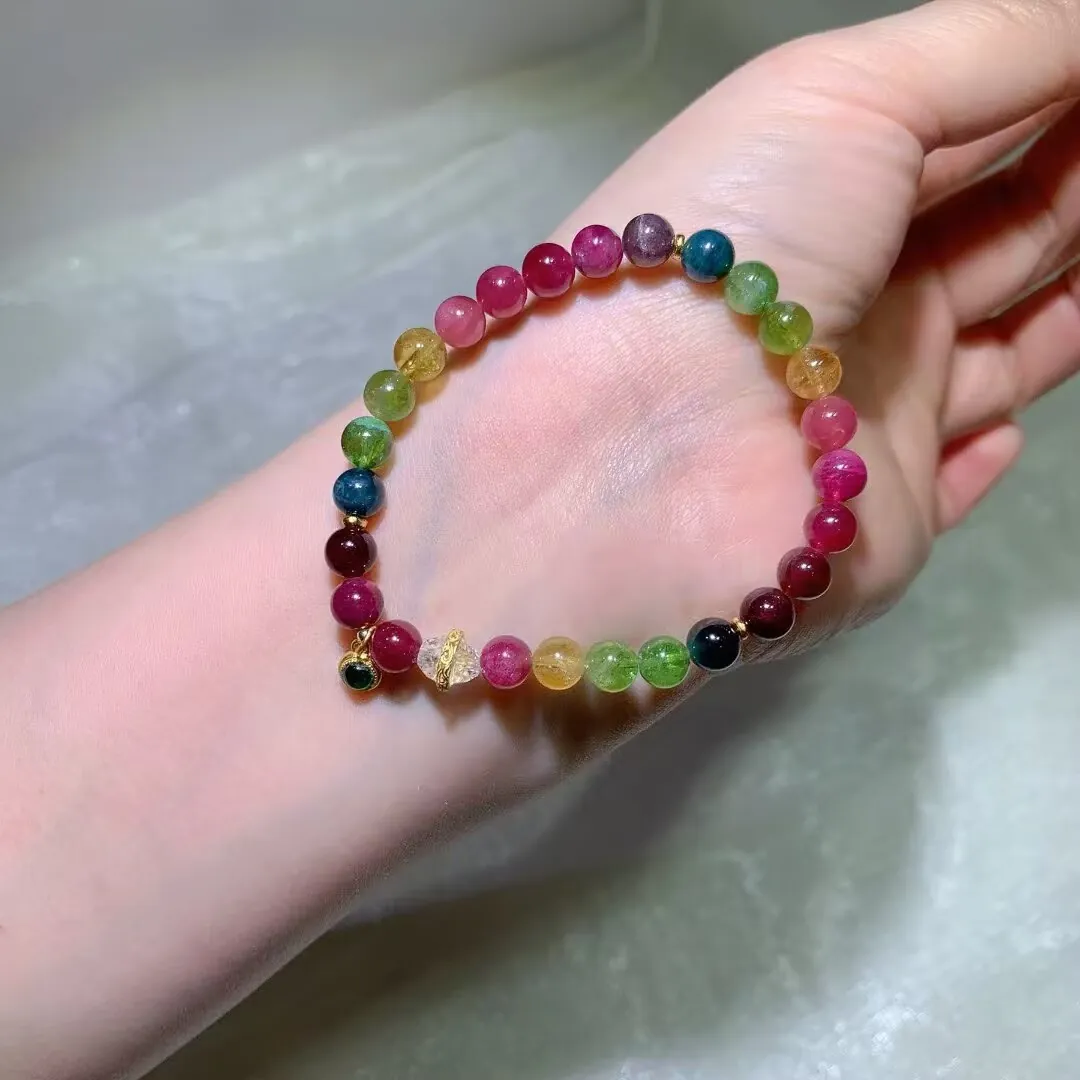 LME JewelryNatural Candy Tourmaline Bracelet (6.5mm)for manifesting your dreams6.5mm rainbow mix · Green charm & clear crystal accent · Vintage-style accents$438View piece →
The 7.2mm strand has slightly larger beads for a bolder rainbow, with a green drop charm and vintage-style accents.
 LME JewelryNatural Candy Tourmaline Bracelet with Green Drop Charm (7.2mm Rainbow Mix)for protection, blessings & luckNatural mixed-color tourmaline · 7.2mm rainbow mix · Green drop charm · Vintage-style accents$418View piece →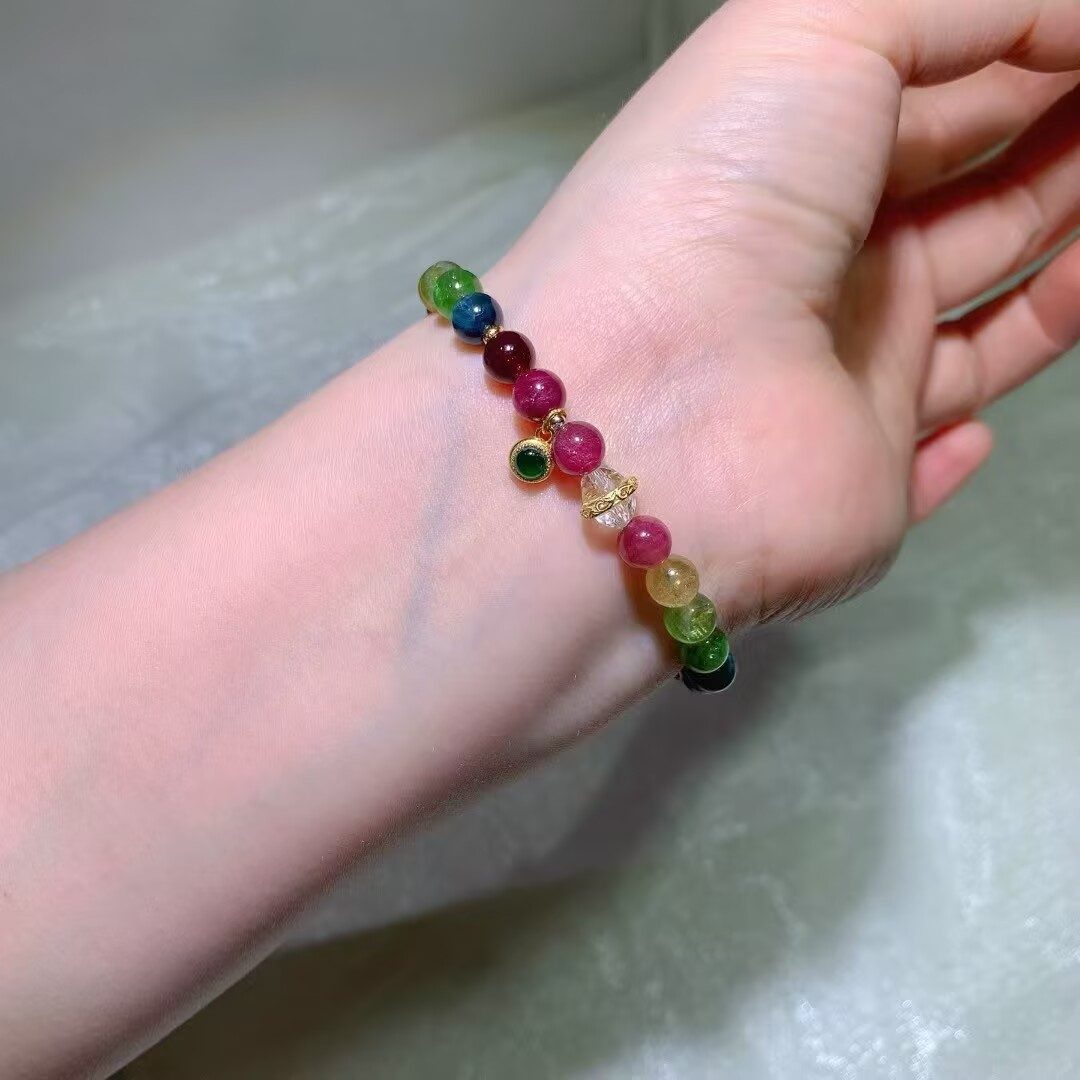
Because every stone is natural, the color mix differs slightly from bracelet to bracelet. That is part of the charm. If you would like extra close-up photos before you order, just ask us on WhatsApp.
An October Birthday Gift That Feels Personal
- For October birthdays: a whole rainbow on the wrist, so you never have to guess her favorite color.
- For an eighth anniversary: tourmaline is the traditional gem for year eight.
- For a new chapter: a new job, a new home or a graduation. It carries a wish for luck and blessings.
- For yourself: a small daily dose of joy.
Every order ships in our LME gift box, ready to give. US shipping is free on orders of $99 or more, otherwise a flat $8.99. New here? Use code WELCOME15 for $15 off your first order of $150 or more.
Make It Yours
Want a different bead size, a strand sized exactly to your wrist, or a different charm? Start a request on our custom page or message us on WhatsApp (+86 187 7912 3450), and we will design it with you. Browse every piece on the LME Jewelry homepage.
Sources and Further Reading
- GIA, tourmaline gem description and birthstone notes (properties, history, October birthstone, 8th anniversary)
- GIA, tourmaline care and cleaning guidance (heat and temperature sensitivity)
- Mineralogy references on pyroelectric minerals (the "ash puller" story)
Last reviewed by the LME Jewelry team on 2026-09-28.
Crystal meanings come from tradition and personal experience. They are not a substitute for medical advice or treatment.
Frequently asked questions
What is the birthstone for October?
October has two birthstones, opal and tourmaline. Opal is the older, traditional choice. Tourmaline, and pink tourmaline in particular, is the modern choice many people prefer because it is tougher for everyday wear and comes in almost every color.
What does tourmaline symbolize?
In crystal tradition tourmaline is known as a "lucky stone". It is linked with protection from negative energy, good fortune and blessings, a lighter mood and emotional balance. Each color adds its own gentle meaning, from love (pink) to growth (green) and calm expression (blue).
What chakra is tourmaline associated with?
It depends on the color. Pink and green are linked with the heart chakra, black with the root, yellow with the solar plexus and blue with the throat. A mixed candy tourmaline strand is traditionally seen as balancing all seven chakras.
Is tourmaline good for everyday wear?
Yes. Tourmaline is about 7 to 7.5 on the Mohs scale, so it handles daily wear well. Take your bracelet off for showers, swimming, workouts and sleep to protect the stretch cord and the vintage-style accents, and keep it away from strong heat.
Can tourmaline get wet?
The stone itself is fine with a quick rinse, but a stretch bracelet lasts longer when it stays dry. Wipe it with a soft, slightly damp cloth instead of soaking it, and avoid hot water.
Can I sleep with a tourmaline bracelet on?
We suggest taking it off at night so the cord is not stretched while you sleep. Many people rest it on the nightstand instead, as a small cue to slow down and let the day go.
Which wrist should I wear tourmaline on?
In crystal tradition the left wrist is the receiving side, so wear it there to welcome luck and joy. The right wrist is the releasing side, for letting go of stress and feeling protected. There is no wrong choice.
Is candy tourmaline a good October birthday gift?
It is one of the most cheerful options, because a rainbow strand holds every tourmaline color at once, so you do not have to guess someone's favorite. Tourmaline is also the traditional gem for an eighth wedding anniversary.
How can I tell if a tourmaline bracelet is real?
Look for natural, uneven color with some two-tone beads, fine inclusions inside the beads, and color that shifts a little as you turn them. Be careful with color concentrated around drill holes, perfectly identical beads, round bubbles and very low prices.
Pieces in this story
Natural Candy Tourmaline Bracelet (6.5mm)
Natural Candy Tourmaline Bracelet (6.5mm)
for manifesting your dreams
6.5mm rainbow mix · Green charm & clear crystal accent · Vintage-style accents
Natural Candy Tourmaline Bracelet with Green Drop Charm (7.2mm Rainbow Mix)
Natural Candy Tourmaline Bracelet with Green Drop Charm (7.2mm Rainbow Mix)
for protection, blessings & luck
Natural mixed-color tourmaline · 7.2mm rainbow mix · Green drop charm · Vintage-style accents
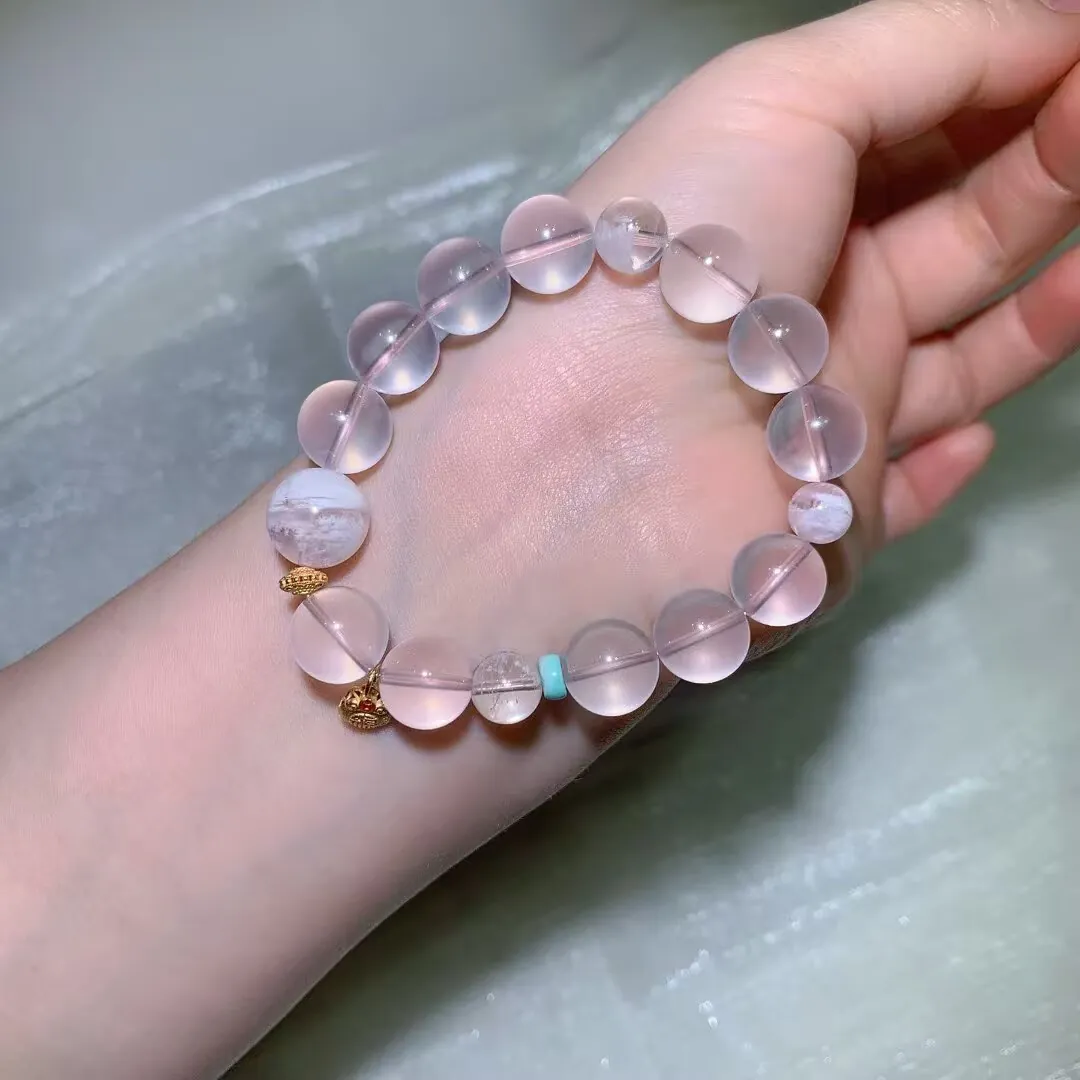
Natural Star Rose Quartz Bracelet (12mm)
Natural Star Rose Quartz Bracelet (12mm)
for self-love & tenderness
12mm star rose quartz · Sky-blue spacer & charm · Vintage-style accents
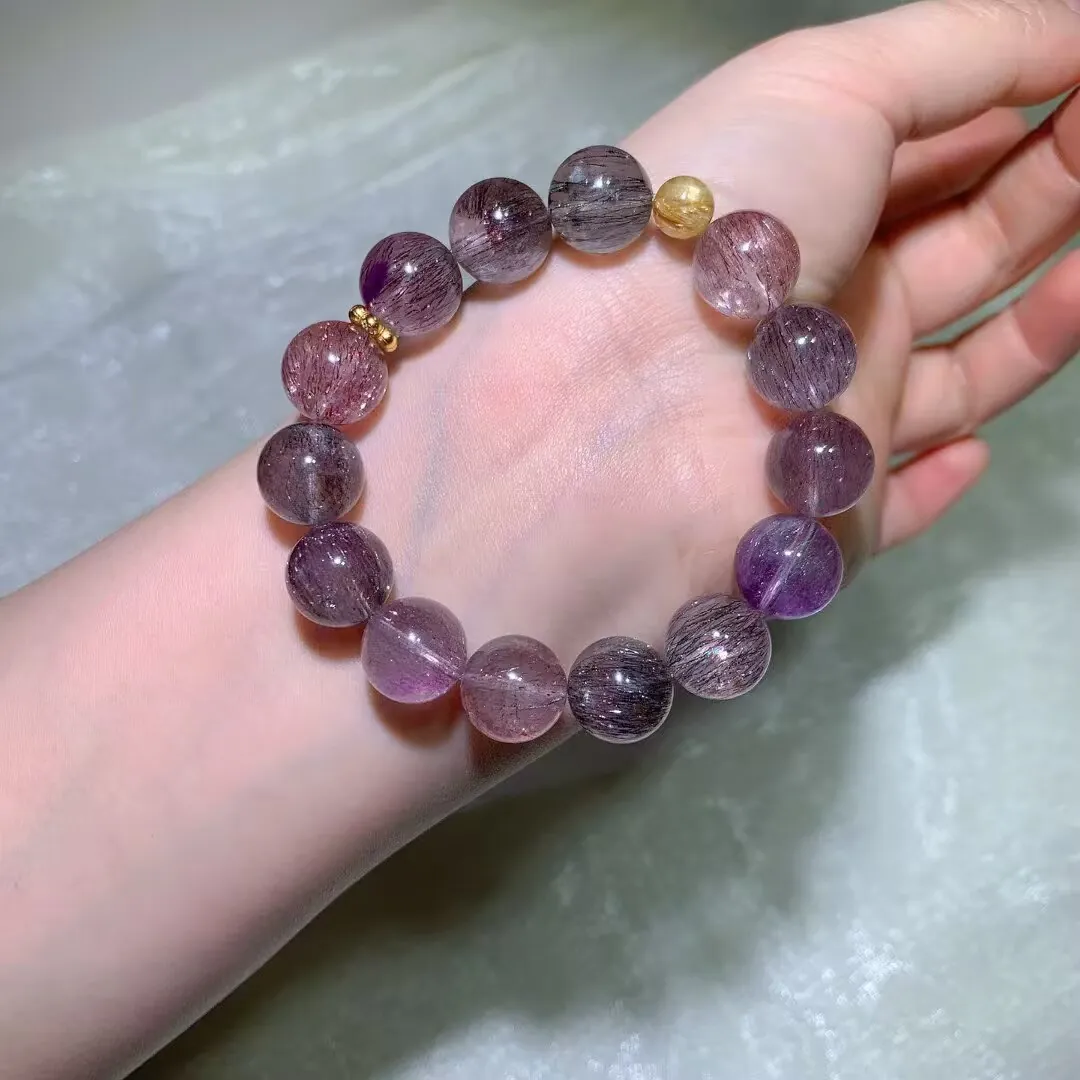
Natural Super Seven Crystal Bracelet (14.3mm)
Natural Super Seven Crystal Bracelet (14.3mm)
for healing & inner balance
14.3mm Melody Stone beads · Golden rutilated accent · Vintage-style accents